What Are the Most Effective Treatments for Lung Cancer?
For most people, a lung cancer diagnosis feels like a whirlwind.


Jump to:
- The Foundation: Knowing What We Are Dealing With
- Curative Treatments for Early Stage Disease
- Surgery
- Stereotactic Ablative Radiotherapy (SABR).
- Systemic Therapies: Treating the Whole Body
- Targeted Therapies
- Chemoimmunotherapy
- Advanced Precision Radiotherapy
- Treating Oligometastatic Disease
- The Importance of a Plan
- About Dr. James Wilson
You sit in a room, someone mentions a shadow on a scan, and suddenly, you’re drowning in appointments and medical jargon. It is a lot to take in.
One of the first questions patients ask me is, "What is the best treatment?"
I wish there were a simple answer. The reality is that lung cancer treatment has advanced significantly, replacing broad strategies with personalised therapies. It's no longer just a choice between "cut it out" or "poison it", referring to surgery or chemo.
Science has moved so fast in the last five years that it is hard even for doctors like me to keep up sometimes. But that’s good news for us. It means we don't just treat lung cancer. We treat your specific type of lung cancer.
Here is how we break it down.
The Foundation: Knowing What We Are Dealing With
Before we even talk about treatment, we need the blueprint.
In the past, we just looked at whether it was Non-Small Cell or Small Cell lung cancer. That was it. Now, we go much deeper.
We use molecular profiling to examine the tumour's genetic makeup. We are looking for specific mutations, which are small errors in the DNA that drive cancer growth. We don't guess anymore. We look at the blueprint.
If we find a specific target, we can use a specific drug to hit it. It changes everything.
Curative Treatments for Early Stage Disease
If we catch it early, the goal is simple. Cure the cancer.
Surgery
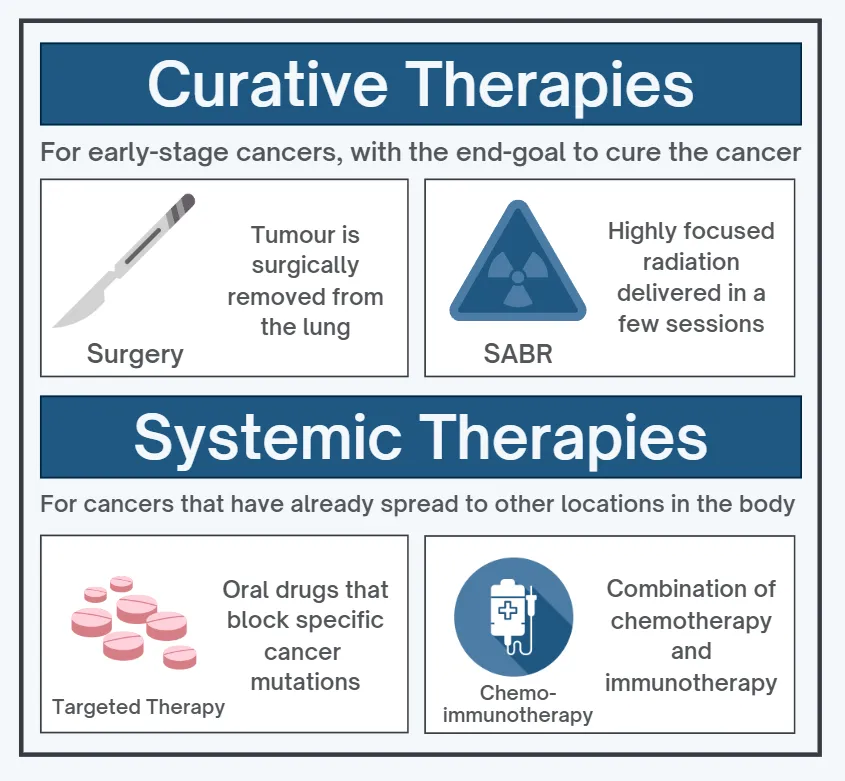
For many people, surgery is still the gold standard. If the tumour is in a good spot and you are fit enough, a surgeon wil remove it. This course is still one of the most effective in getting rid of the cancer.
Stereotactic Ablative Radiotherapy (SABR).
I am a huge advocate for this.
SABR uses extremely precise, high-dose radiation to destroy the tumour. The amazing thing is that it requires no knife and no hospital stay. You come in, have the treatment, and go home for tea.
For early-stage lung cancer, the control rates are excellent. I mean, we are talking about success rates similar to those of surgery, but without the hospital recovery time.
Systemic Therapies: Treating the Whole Body
If the cancer has spread, or if there is a risk of microscopic cells floating around, we need treatments that reach the whole body.
Targeted Therapies
Remember that genetic blueprint I mentioned? This is where it pays off.
If your cancer has a specific mutation (like EGFR or ALK), we can use targeted drugs to block it. These are often just tablets you take at home. They tend to have fewer side effects than chemotherapy because they are precise. They ignore the healthy cells and go straight for the cancer.
Chemoimmunotherapy
Chemoimmunotherapy sounds like a bit of a mouthful, but the concept is actually quite simple.
It’s about attacking the cancer from two sides at once.
On one hand, you have chemotherapy. That is the heavy lifter. It goes in and kills rapidly dividing cells to shrink the tumour down quickly.
Then you have immunotherapy. This is the clever bit. Cancer is smart, you see. It knows how to hide from your body’s defences. Immunotherapy strips away that disguise and teaches your own immune system to spot the cancer and fight back.
When we use them together, it is a bit of a one-two punch. The chemo creates the opening, and the immunotherapy keeps the pressure on long-term.
This approach has completely changed the landscape for lung cancer. We are now seeing outcomes we didn't see even just ten years ago.
Of course, chemoimmunotherapy isn't right for everyone. We still need to look at the genetics and your overall health to make sure it fits. But as a step towards smarter, more effective treatment? It is massive.
Advanced Precision Radiotherapy
Sometimes, a tumour is in a tricky spot. Maybe it is right next to the heart or the spinal cord.
This is where technology like the MR-Linac or CyberKnife comes in. These machines allow us to see the tumour moving in real-time as you breathe, so we can destroy the cancer while protecting the healthy tissue around it. With advanced precision radiotherapy, we can deliver high doses of radiation with millimetre-precision to the affected areas.
It means we can treat tumours that were previously considered "untreatable".
Treating Oligometastatic Disease
There is also a scenario called "oligometastatic disease". This is when the cancer has spread, but only to a few specific spots. Maybe one in the lung and one in the adrenal gland.
In the past, this was just treated as advanced disease. Palliative care.
Now, we treat it aggressively. We use SABR to zap those individual spots. The goal isn't just to manage the decline. It is to extend life and keep the disease under control for as long as possible.
The Importance of a Plan
So, what is the most effective treatment?
It depends on the blueprint. It depends on your health. It depends on what you want.
There is no "best" treatment. There is only the best treatment for you.
It’s very hard to navigate this alone. But with the right support, the right team, and the right science, we can throw a lot at this disease.
About Dr. James Wilson
Dr. James Wilson is a consultant oncologist specialising in lung cancer and advanced radiotherapy. Based in Central London, he practices privately, offering prompt diagnosis, clear treatment plans, and steady guidance when it matters most.