Leading Causes of Lung Cancer
Lung cancer remains one of the most common cancers in the UK, with around 48,000 new diagnoses each year. It is also one of the leading causes of cancer-related death.


Jump to:
When we talk about causes, what we are really discussing is risk. It does not develop because of a single event. It usually reflects long-term exposure to factors that damage lung cells. Understanding those factors helps frame prevention. It also helps explain why some people develop the disease, and others do not.
Smoking: Still the Primary Cause
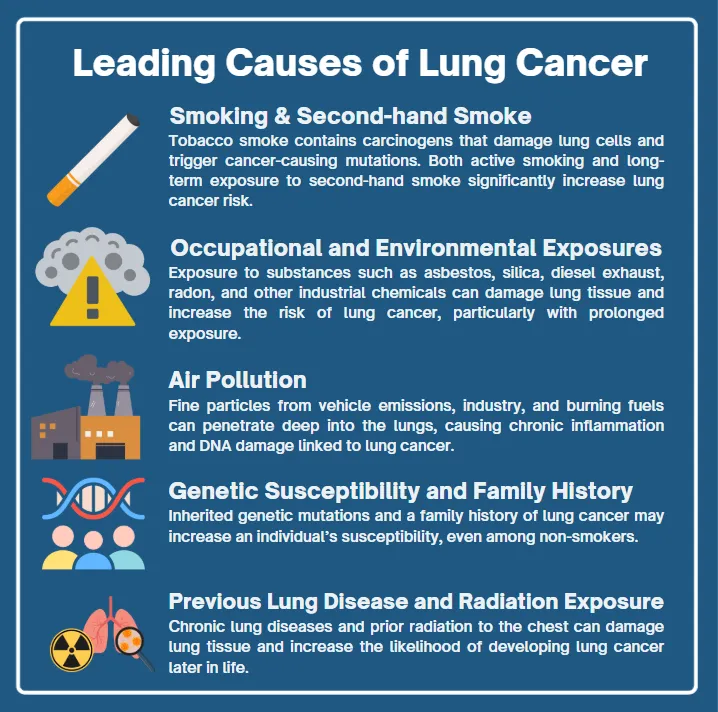
Smoking remains the single biggest risk factor. In the UK, around 72 percent of cases are caused by tobacco smoking, making it by far the most significant contributor.
The relationship is cumulative. Both duration and intensity matter, but years of exposure often carry particular weight. Even people who describe themselves as light smokers can carry meaningful risk if that exposure continues over decades.
Tobacco smoke contains carcinogens that damage DNA within lung cells. With repeated exposure, genetic changes accumulate. If repair mechanisms fail, abnormal cells can develop.
Importantly, stopping smoking reduces risk at any age.
The risk does not return completely to that of a lifelong non-smoker, but it falls steadily over time. To be honest, that reduction is clinically meaningful even later in life.
For patients navigating diagnosis and staging, discussions around management often take place within the framework of comprehensive lung cancer care, where treatment planning depends heavily on tumour type and extent of disease rather than smoking history alone.
Second-Hand Smoke
Passive exposure also contributes. Non-smokers who live with smokers have a measurable increase in risk compared with those who are not exposed.
The absolute risk is lower than that of active smokers. However, long-term household exposure does carry consequences. Children growing up in smoking environments accumulate exposure over many years.
Public smoking bans have had a measurable public health impact. Reducing indoor exposure reduces cumulative harm. You know, these are gradual changes, but they matter at scale.
Occupational and Environmental Exposures
Certain workplace exposures are recognised causes. Asbestos remains the most significant historically.
Inhaled fibres lodge in lung tissue, triggering chronic inflammation. The latency period can extend over decades. Many patients diagnosed today were exposed many years ago, often without realising the long-term implications at the time.
Other recognised occupational risks include:
-
Silica dust
-
Diesel exhaust
-
Metal fumes
-
Industrial chemicals
Radon exposure is another contributor. Radon is a naturally occurring radioactive gas. In parts of the UK, particularly the South West, indoor levels can be elevated. Nationally, radon is estimated to contribute to a small percentage of cases. Testing is straightforward, and mitigation measures are effective where levels are raised.
Air Pollution
Air pollution is increasingly recognised as a contributor. The effect is smaller at an individual level compared with smoking, but significant at the population scale.
Fine particulate matter, particularly PM2.5, penetrates deep into lung tissue. Chronic exposure leads to inflammation and cellular damage.
This matters. We are seeing more patients who have never smoked. Their cancer is often driven by genetic mutations rather than tobacco-related damage. Environmental exposure may be one of several contributing factors. I mean, lung cancer is not a single disease with a single cause. It reflects overlapping risks accumulated over time.
Genetic Susceptibility and Family History
Lung cancer is not typically considered a strongly inherited cancer in the way that breast or bowel cancer can be. However, there is evidence of familial clustering.
If a first-degree relative has had it, particularly at a younger age, the risk is modestly increased. This may reflect shared genetic vulnerability, shared environmental exposure, or both.
In practice, genetic mutations such as EGFR or ALK are more relevant to treatment planning than to predicting who will develop lung cancer. These mutations are typically acquired within the cancer cells rather than inherited. They are not the kind of gene mutations that you inherit or pass on to your children.
It is also worth saying that most people with a family history will never develop lung cancer. Risk is influenced by multiple interacting factors rather than a single gene.
Previous Lung Disease and Radiation Exposure
Chronic lung conditions such as COPD and pulmonary fibrosis are associated with increased risk. This may be due to long-standing inflammation and structural lung damage.
Prior radiotherapy to the chest, for example, for Hodgkin lymphoma or breast cancer, can also increase the risk many years later.
The absolute risk remains relatively low, but it is recognised.
In practice, when patients have these backgrounds, we maintain a lower threshold for investigating persistent symptoms. Persistent cough, unexplained weight loss, or breathlessness warrant timely imaging.
Early-stage lung cancer is often treatable with curative intent. Late-stage disease is more complex. Time matters.
From Risk to Treatment Decisions
Understanding causes is important. But once a diagnosis is made, the focus shifts quickly.
In practice, what determines outcome is not simply why the cancer developed, but how early it is detected and how precisely it is staged. Tumour biology, molecular profiling, and overall health all guide the next steps.
Some patients will be suitable for surgery. Others may benefit from advanced radiotherapy. Increasingly, targeted therapies and immunotherapy play a central role.
To be honest, this is where clarity becomes critical. Lung cancer treatment is highly individualised. Decisions are made through multidisciplinary review. The aim is to balance effectiveness with safety, particularly where time is sensitive.
That shift, from understanding risk to planning treatment, is often where specialist input makes the greatest difference.
About Dr. James Wilson
Dr. James Wilson is a consultant oncologist specialising in lung cancer and advanced radiotherapy. He works full-time in private practice in Central London, focusing on early diagnosis, precise staging, and individualised treatment planning. His approach centres on clear explanation, transparent discussion of options, and calm guidance at a time when decisions often need to be made without delay.