Chemotherapy vs Proton Therapy for Cancer Treatment: What’s the Difference?
People often ask me this question as if there is a winner. There isn’t.


Jump to:
- The 30-second definitions
- How they work (and why that matters)
- Chemotherapy: systemic treatment
- Proton therapy: local treatment
- What each treatment is used for
- When chemotherapy is commonly used
- When proton therapy is commonly used
- A lung cancer example
- What treatment actually looks like
- What chemotherapy is like day to day
- What proton therapy is like day to day
- Side effects: a fair way to compare them
- Chemotherapy side effects (general)
- Proton therapy side effects (often local)
- The key comparison
- Effectiveness: what we can and can’t claim
- Cost, access, and practicality
- How clinicians decide between chemotherapy, proton therapy, or both
- Where is the cancer?
- What is the goal?
- What does the anatomy look like?
- What is your baseline health?
- What trade-offs are acceptable to you?
- Can you have both?
- Questions worth asking your team
- The bottom line
- About Dr James Wilson
Chemotherapy and proton therapy are different tools for different jobs. One treats the whole body. The other targets a specific area with precision radiotherapy. Sometimes you need one. Sometimes you need both. Sometimes, you need a different treatment altogether.
The 30-second definitions
Chemotherapy (chemo) is a kind of drug treatment that travels through the bloodstream. Because it goes everywhere, it is a systemic treatment. That is useful when cancer cells might be in more than one place, even if we cannot see them on a scan.
Proton therapy is a type of radiotherapy. Instead of using X-rays (often called photon radiotherapy), it uses protons, which are positively charged particles. The main advantage is control over where the radiation dose lands, which can reduce the dose to nearby healthy tissues in some cases.
So yes, both treat cancer. But they do it in very different ways.
How they work (and why that matters)
Chemotherapy: systemic treatment
Chemotherapy drugs circulate in your bloodstream. The aim is to damage or kill cancer cells, wherever they are.
Because chemo is systemic, side effects can also be systemic. It can affect healthy cells too, which is why people can feel generally unwell, tired, or prone to infection depending on the regimen and their individual tolerance.
Proton therapy: local treatment
Radiotherapy treats a defined area. Proton therapy is still radiotherapy, but with a different type of beam.
Physics is the key point. Protons can be planned so that most of the energy is released at a specific depth (often explained clinically as the “Bragg peak”), and there is far less radiation continuing beyond the target compared with standard X-ray radiotherapy. In practice, that can mean:
- Less “spill” into healthy tissue behind the tumour
- Potentially lower dose to organs that sit right next to the treatment area
This matters most when tumours are close to structures we really want to protect.
What each treatment is used for
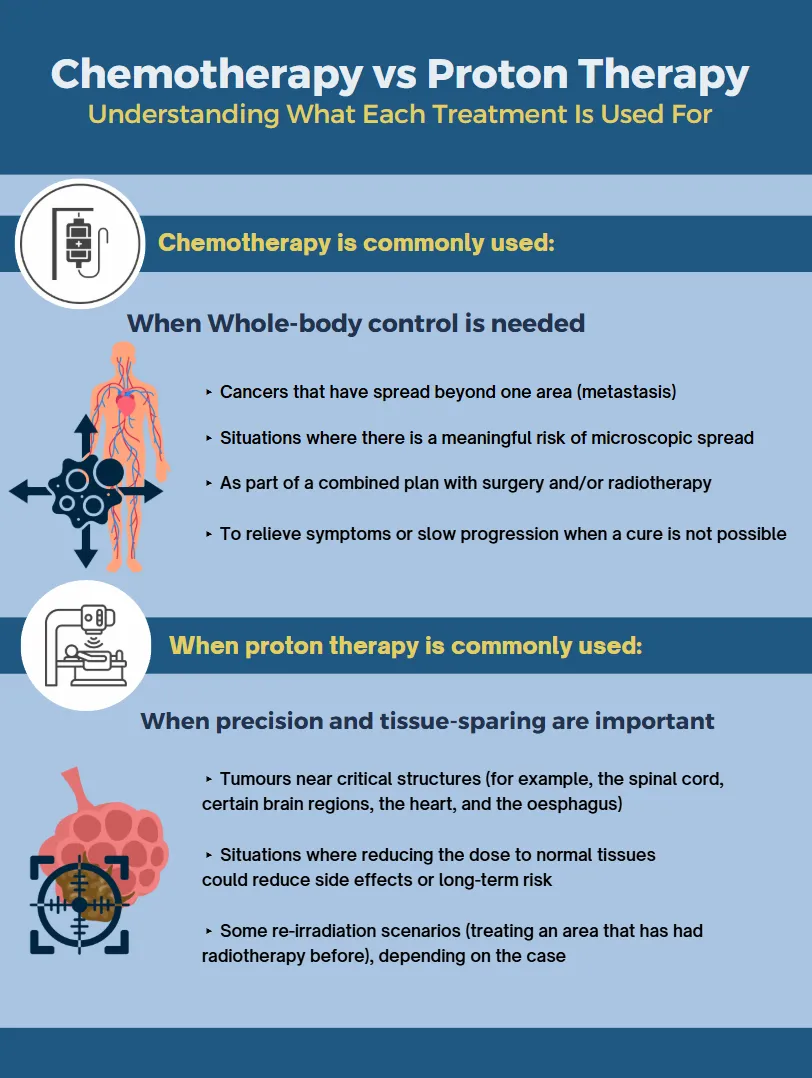
When chemotherapy is commonly used
Chemotherapy is often used when we need whole-body control, for example:
- Cancers that have spread beyond one area (metastasis)
- Situations where there is a meaningful risk of microscopic spread
- As part of a combined plan with surgery and/or radiotherapy
- To relieve symptoms or slow progression when a cure is not possible
When proton therapy is commonly used
Proton therapy is considered when radiotherapy is needed, but sparing healthy tissue could make a meaningful difference. That might include:
- Tumours near critical structures (for example, the spinal cord, certain brain regions, the heart, and the oesophagus)
- Situations where reducing the dose to normal tissues could reduce side effects or long-term risk
Some re-irradiation scenarios (treating an area that has had radiotherapy before), depending on the case
A lung cancer example
In the chest, everything is crowded: lungs, heart, oesophagus, major airways, and spinal cord. For some lung cancer patients, proton therapy reduces the radiation dose to these nearby organs compared with standard radiotherapy plans, which can be particularly relevant for:
- Centrally located tumours
- People with reduced lung reserve (such as COPD)
- People with existing heart disease
- Cases where treatment has to be given close to the oesophagus or major airways
- Some patients need re-treatment after prior radiotherapy
It is not a magic solution. It is an option worth assessing properly as it directly targets cancer cells. A consulting oncology specialist would be the best person to seek advice from about cancer treatment.
What treatment actually looks like
What chemotherapy is like day to day
Chemotherapy is usually given in cycles. You’ll follow a schedule and receive treatment on a particular day (or days), then have a rest period to allow recovery. It may be delivered:
- Through a cannula or drip, sometimes via a port
- As tablets or capsules for certain drugs
- Occasionally, by injection, depending on the drug
Monitoring is a big part of it. Blood tests, symptom review, and scans at intervals to check whether the treatment is doing its job.
What proton therapy is like day to day
Proton therapy has a planning phase first. You will have imaging (often CT, sometimes MRI) to map the target and decide the beam angles and dose.
Treatment is usually delivered five days a week for several weeks, though this varies by tumour type and the plan. Each session involves careful positioning and checks. The beam delivery itself is painless. You do not “feel” the radiation.
After treatment, you are not radioactive. You can go home and get on with your day, even if you are tired.
Side effects: a fair way to compare them
This is where people most want a straight answer. “Which has fewer side effects?”
The honest answer is: it depends on the job we’re asking the treatment to do, the dose, and your starting point.
Chemotherapy side effects (general)
Because chemo is systemic, side effects can be general and may affect the whole body. Depending on the drugs, dose, and the person, this can include fatigue, sickness, bowel changes, appetite changes, lowered blood counts and infection risk, and sometimes hair loss.
Proton therapy side effects (often local)
Radiotherapy side effects are often related to the area being treated. Proton therapy can still cause side effects, but because we can sometimes spare healthy tissues better, the aim is to reduce the collateral damage.
Common side effects described across proton therapy include fatigue and skin changes in the treated area, as well as soreness in the region treated. The exact pattern depends heavily on what is being treated.
The key comparison
- Chemo tends to cause system-wide effects because it goes system-wide.
- Proton therapy tends to cause area-specific effects because it is local.
That’s the most useful way to remember it.
Effectiveness: what we can and can’t claim
A common misconception is that proton therapy is “stronger” than standard radiotherapy.
To be honest, this is not necessarily true of all cases.
In many cancers, proton therapy is used to deliver an effective radiotherapy dose to the tumour while reducing the dose to healthy tissue. The hoped-for win is often lower toxicity, rather than dramatically better cancer control.
Evidence summaries comparing proton-based chemoradiotherapy with photon-based chemoradiotherapy (in certain locally advanced cancers) have suggested:
- Similar cancer outcomes in the data we have so far (for example, no clear differences in disease-free or overall survival in some reports)
- Reduced rates of certain serious side effects in some patient groups
But there are caveats. A lot of the evidence is not from perfect head-to-head randomised trials, and access and recruitment issues can affect the quality of comparisons. More high-quality trial data is still being built.
So the sensible framing is: proton therapy may reduce side effects in selected patients, with cancer control that appears comparable in certain settings, but it is not automatically “better” for everyone.
Cost, access, and practicality
This is the unglamorous part, but it matters.
Proton therapy is not as widely available as standard radiotherapy. It may involve travel and a daily attendance schedule for weeks. Insurance coverage can also be variable depending on where you are and what the indication is.
Chemotherapy is more widely available, but it comes with its own practical burdens: repeated blood tests, infusion visits (for IV regimens), and sometimes an increased risk of needing urgent care if complications occur.
Neither option is “easy”. They are just different.
How clinicians decide between chemotherapy, proton therapy, or both
This is the checklist behind the scenes:
Where is the cancer?
If the cancer is localised (confined to one tumour or one region), we can often treat it with local therapies like surgery or radiotherapy because we are aiming at a defined target. If it is widespread (metastatic, or likely to have microscopic spread), we usually need a systemic treatment like chemotherapy or immunotherapy because we are treating the whole body, not just one spot.
What is the goal?
Treatment choices look very different depending on the aim. If the goal is cure, we tend to accept more intensive treatment if it gives a realistic chance of long-term survival. If the goal is control (keeping cancer stable for as long as possible), we focus on maintaining function and minimising avoidable toxicity. If the goal is symptom relief or quality time, we prioritise what helps you feel and function better, and we avoid treatments that take more than they give.
What does the anatomy look like?
The same cancer stage can be very different depending on where the tumour sits. If it is close to critical structures like the heart, spinal cord, oesophagus, major airways, or large blood vessels, the margin for error is smaller. In those situations, the choice of radiotherapy technique matters more because we are trying to treat the tumour properly while keeping the dose to nearby organs as low as possible.
What is your baseline health?
Two people can have the same scan and tolerate treatment completely differently. Things like lung function, heart disease, kidney or liver issues, past infections, and general fitness affect how safely you can get through treatment and recover between steps. Previous radiotherapy is also important because it limits how much dose normal tissues can safely receive again.
What trade-offs are acceptable to you?
This is the part that often gets overlooked, but it is central. Some treatments demand a lot of time (daily appointments), travel, and can bring side effects or uncertainty about the benefit. Others may be less disruptive but also less likely to achieve a particular goal. There is no universally “right” trade-off. The right choice of treatment is the one that fits your priorities, your tolerance for risk, and what you want your life to look like during treatment.
The good plans are the ones where the goal is clear, and the treatment matches it.
Can you have both?
Yes, and this is extremely common.
Chemotherapy and radiotherapy are often combined in certain cancers and stages. Proton therapy can be used as the radiotherapy component in some patients, particularly if reducing the dose to normal tissues is important.
The sequence and combination depend entirely on cancer type, stage, and your individual situation. There is no one-size-fits-all.
Questions worth asking your team
If you are deciding between options, these questions usually get you to the truth quickly:
- “Are we treating the whole body, or one area?”
- “What is the aim in my case?”
- “Would proton therapy meaningfully reduce dose to critical organs for me?”
- “What side effects are most likely for my tumour location?”
- “What are the alternatives, and what do we gain or lose with each?”
- “If we start this, what would make us change course?”
The bottom line
Chemotherapy and proton therapy are not rivals.
Chemotherapy is systemic. Proton therapy is a precise, local form of radiotherapy. The right choice depends on what we are trying to achieve, where the cancer is, and what your body can tolerate.
About Dr James Wilson
Dr James Wilson is a consultant oncologist who specialises in lung cancer and advanced radiotherapy. Based in Central London, he works full-time in private practice, focusing on fast diagnosis, clear treatment plans, and calm, practical guidance when time is critical.